

'It's a powerful message:' Wisconsin volleyball coach Kelly Sheffield on 'A Road at Night'
Kelly Sheffield caught up with Badger Observer earlier this week to chat about why the Badgers volleyball team came out to sign autographs before a showing of the powerful documentary.

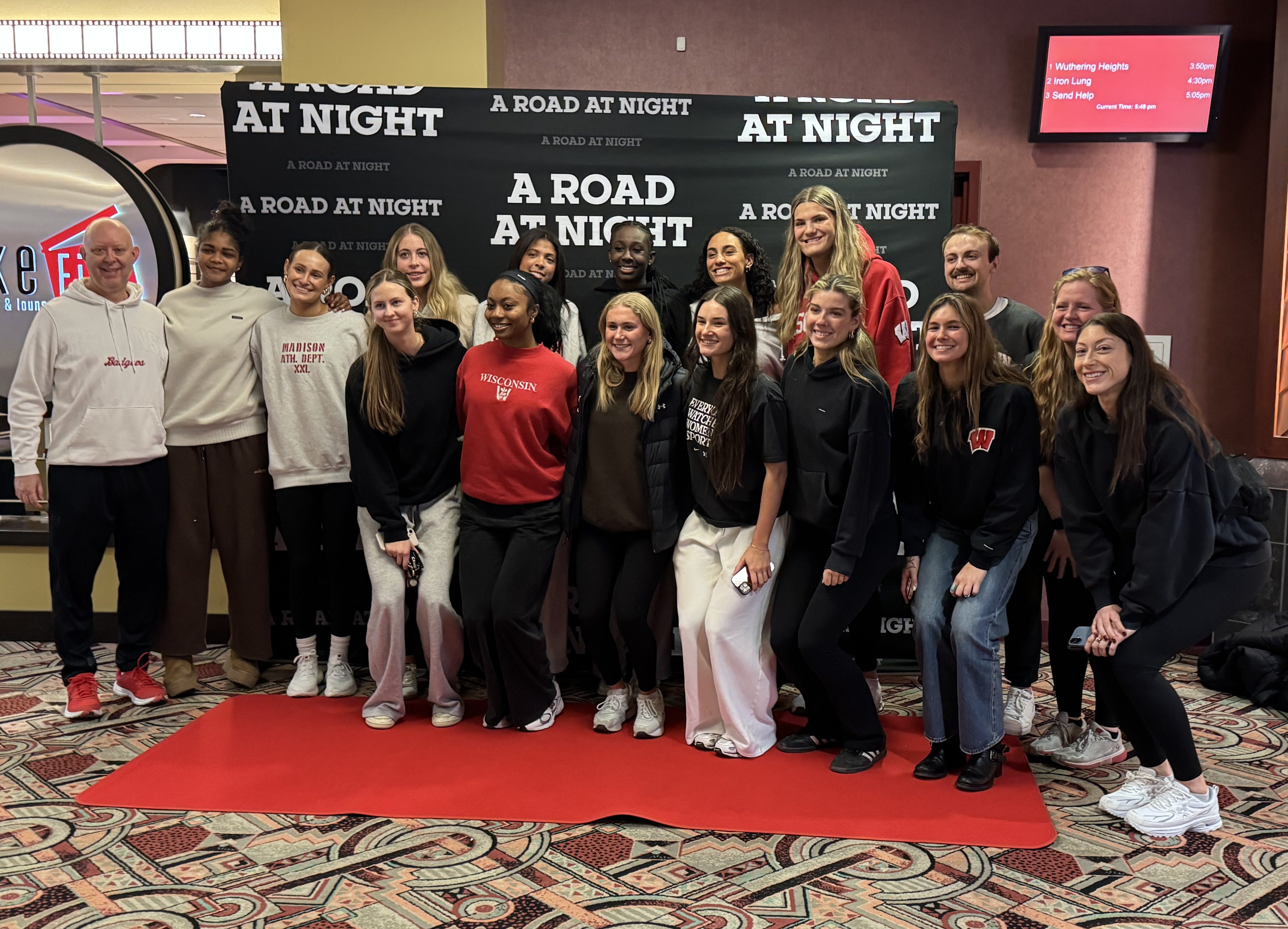
A February evening brought out the University of Wisconsin volleyball team, and a noticeable amount of Badgers faithful, to the movies.
Coach Kelly Sheffield stood and talked to fans, posing for photos at one point, while players sat at a row of tables signing autographs at Marcus Point Cinema on the far west side of Madison on Feb. 18. It was an impressive number of people for a 5:50 p.m. midweek showing, but it wasn’t just any film.
The program was among a few Wisconsin teams that’s recently showed their support for “A Road at Night.” The documentary from director John Roach, according to one description on its site, details the “life, legacy and resiliency” of former Wisconsin player and assistant Howard Moore.
Its run will now extend in Madison through March 11 at Marcus Point Cinema, according to Roach Projects, and it previously ran at Majestic Cinema of Brookfield in Waukesha from Feb. 20 to March 5. Badger Observer also confirmed Thursday with Roach Projects that its share of the ticket proceeds will support Moore’s ongoing care and the future of his son, Jerell.
Sheffield’s motivation to support this film, and finding a path to do so, was multi-pronged. Hearing the news of the vehicle crash caused by a drunk driver that resulted in the deaths of Moore’s wife, Jennifer, and daughter Jaidyn in May 2019 is one of those moments that will stay with Sheffield forever.
He explained Moore’s ability to make one feel like you had a friend for life just minutes into meeting him. Sheffield also said that Jennifer was one of “the closest people within the athletic department” to his wife, Kathy, in terms of reaching out and having talks.
He laughed when recalling visiting Moore in the hospital with an handful of other coaches after the accident. It was the same day Michigan introduced Juwan Howard as its new men’s basketball coach.
“Juwan and Howard are childhood friends,” Sheffield said Wednesday. “And it was funny listening to Howard talked to the TV, talking to Juwan through the TV, and just kind of busting his chops while the interview was going on.
“You kind of fast forward to where we are right now.”
That Michigan news conference was on May 30, 2019, but two months later, Wisconsin released a statement on behalf of the Moore family that Moore underwent a cardiac arrest episode on way to the hospital.
Moore eventually returned to the center of the Kohl Center court nearly five years later in March 2024. A long, boisterous fan ovation welcomed him, as former teammate Rashard Griffith pushed him in a wheelchair.
Sheffield wanted the story to be told and also raise funds for the Moore family. Tim Valentyn, a prominent agent who represents Sheffield, also served as executive producer for the film. Among the ideas they discussed to promote the documentary included buying tickets for an entire showing and handing them out to people, but logistics became tough as they pursued that option.
Then the idea came of bringing the volleyball team out to a showing, fresh off another Final Four appearance but with new transfers and all five freshmen enrolling midyear,
“So that was the road that we decided to go to just see if there's somebody that's paying attention to that, to our program, but would have otherwise missed the opportunity to see this film,” Sheffield said.
Another part of the equation was educating his volleyball program on Moore, who he called “a great man, this great family, of what team is.”
“The story behind the accident. Him being an athlete here,” Sheffield said. “Wasn’t a player that played a ton, but just really, really critical to the program’s success and catapulting them for the next 25 years or so. And I thought that was a really important message to our players. because I think sometimes, the top three or four players on any team kind of know they’re important. How do you get the others to kind of grab a role and own it and be influential? Howard’s story is clearly that.”
“Then the other part is just from a standpoint of how do we grow deeper roots with the players that come here? Like years ago, you’d have most players on most teams, or maybe in state or from around here, have been going to camp for years, and they just knew the history of a place, of a program. And right now they’re just so much in and out, and I think you’re always looking for opportunities to share with your team and your players who came before you. Maybe the spirit of the place, and I thought that was just beautifully executed in the film.”
Sheffield spoke with the players about the film a few days after attending that Feb. 18 showing, which he believes “really hit them.”
“There wasn’t a dry eye in the theater,” Sheffield said. “It is sad, happy, inspiring. It hits on everything. It’s only the second movie in my entire life that the entire theater just sat there through the credits. Nobody got up to leave until the last credit was done, and then everybody exited in total silence. The only other time I’ve ever witnessed that is when I went in the movie theater when I was younger and saw Schindler’s List.
“It was just so beautifully done and told a powerful story, and that you just want everybody to watch. Yes, there’s a sad component to it as well, but it’s not just a sad film, right? There’s so many uplifting messages in the face of tragedy, of how people respond to things that, that I think kind of talks to your better angels.”
It hasn’t just been the volleyball program that’s come out to support this film. Wisconsin director of football operations John Richter posted a photo of about 20 members of the football program at the cinema two days after the volleyball team.
The men’s basketball and softball teams also activated around the documentary, according to a Wisconsin spokesperson. Sheffield saw the softball squad as he was walking out of that theater that evening last month.
“They're sitting there, and they're in season, right?” Sheffield said. “Just how cool is that?”
Before letting Sheffield move on to other ventures after our Wednesday morning conversation, in what’s been and will continue to be a busy offseason for the longtime Wisconsin coach, he had one more message to give.
“I want people to go out and watch this film,” Sheffield said. “I want them to go out there and watch it with their spouse, with their teenage kids, with friends of the family, get out there and watch it.
“It’s an important message. It’s a powerful message. They will not regret watching this documentary.”