

6 takeaways from Wisconsin Athletics' extension with Under Armour
Sat down with Wisconsin's chief revenue officer to discuss the extension with Under Armour. Here's what stood out.

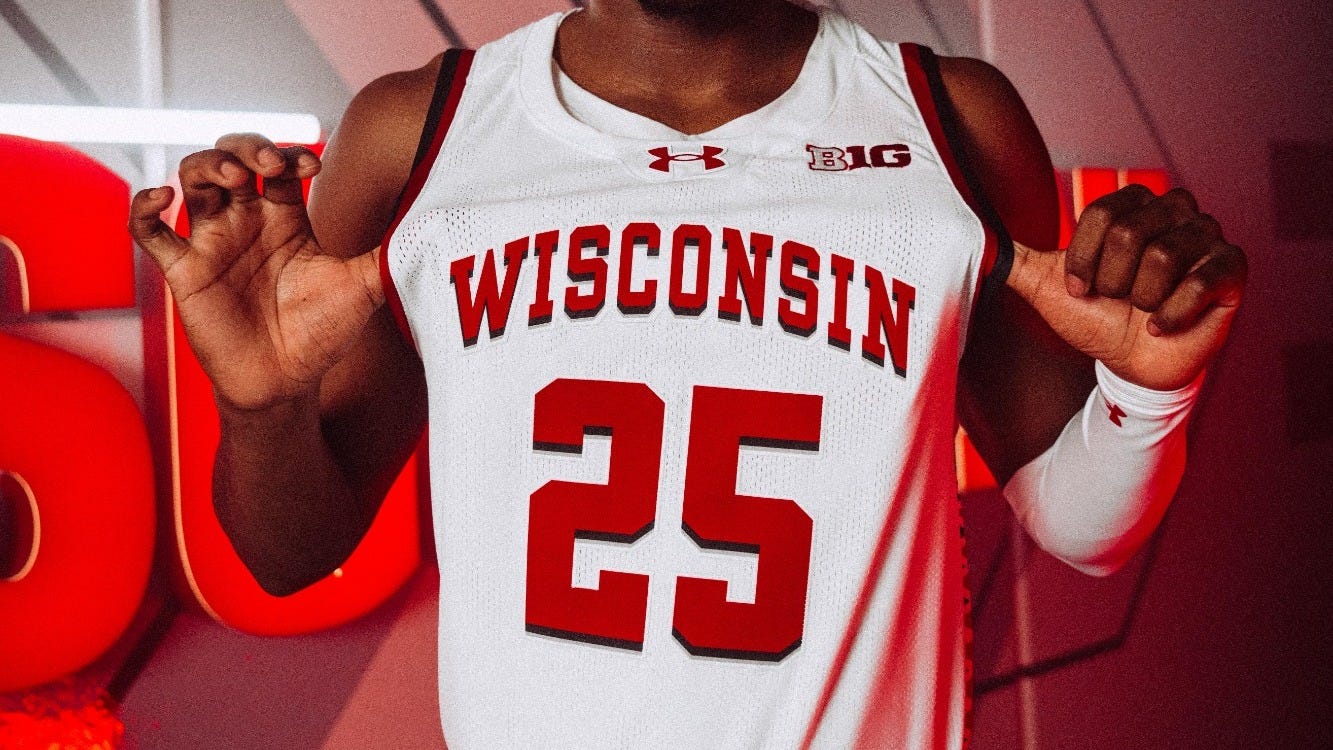
Mitchell Pinta feels like things have come full circle in regards to one brand he knows all too well.
Pinta wasn’t with the University of Wisconsin athletic department when its initial contract with Under Armour began in July 2016, but at the time, he worked on a partnership with the popular outfitter as a sponsorship manager1 for the NFL. Now Wisconsin’s extension with Under Armour was unveiled last month under his watch as the Badgers’ deputy athletic director and chief revenue officer.
“There was a launch here, and there was a launch in New York as well,” Pinta said. “So I actually spent time with Mac (Chris McIntosh) at the time, coach (Barry) Alvarez, my Under Armour clients.
“We were all together at the time, and it’s really funny that now 10 years later, looking back, we’re announcing this extension.”
A lot has changed since July 2016. McIntosh was Wisconsin’s associate athletic director for business department but has taken over as athletic director for Alvarez, who has since retired, and Pinta has returned to his alma mater.
What won’t change is Under Armour being “the Official Outfitter of University of Wisconsin–Madison Athletics,” as seen in a summary provided to Wisconsin’s Board of Regents last month. The new contract has a total minimum gross value of $104.5 million, which is an increase from the $96.75 million under the current agreement. It will keep the two entities tied for at least seven more years, with a three-year extension that could take it until 2036.
Badger Observer sat down with Pinta on Dec. 3 for a 26-minute, on-record conversation after the football program’s early signing period news conference to discuss the Under Armour partnership and the new contract. Here are some takeaways from the chat.
First, some key terms of the deal
Badger Observer has requested the new contract between Wisconsin and Under Armour once it’s fully executed (see: signed on both sides), but here is what was said verbatim from the summary:
Cash Compensation:
UW–Madison would receive an early payout of the remaining rights fees due under the current agreement in the form of a $3 million signing bonus.
UW–Madison would receive annual cash compensation of $3.8 million, paid quarterly. In addition, UW–Madison would be eligible to receive performance bonuses for postseason success across multiple sports. Under the current agreement, UW–Madison receives $4 million in cash, plus performance bonuses.
UW–Madison would receive a $500,000 annual guaranteed minimum licensing royalty, increasing from $450,000 under the current agreement. As noted above, the royalty rate would also increase beyond that applied under the current agreement.
Product Support:
UW–Madison would receive an annual product allotment of Under Armour shoes, apparel, and equipment at no cost to UW-Madison, to outfit its 23 intercollegiate teams. In the final year (2025-26) of the current contract Athletics receives an annual product allotment of $3.05 million in wholesale pricing. In the proposed agreement, that amount increases to $3.2 million.
UW–Madison would receive additional special uniforms for various teams. Under the current agreement Under Armour provides additional uniforms for Football, Men’s and Women’s Basketball, and Men’s Hockey. Under the proposed agreement, that would expand to include Women’s Hockey and Volleyball.
Under the proposed contract, Under Armour would provide a carryover option of up to $175,000 in unused product allowance annually.
Marketing and NIL Activation:
Under Armour would provide UW–Madison with a $75,000 annual marketing fund for enhanced promotional opportunities.
Under Armour would commit an annual minimum of $175,000 to NIL contracts with UW–Madison student athletes for endorsements and appearances.
Wisconsin, in said summary, also compared its extension with two other agreements signed between two SEC schools and Nike:
The financial terms of the proposed agreement are favorable to Wisconsin Athletics, particularly considering the present market environment. Publicly available information and insights from trusted, industry-adjacent contacts confirm that the terms of the renewal are at or near the top of the current market. For example, University of Kentucky began a Page 2 of 4 ten-year renewal of their agreement with Nike in July that provides the school with an annual $7 million product allowance (increasing to $7.5 million in five years); a 15% licensing royalty on Nike-Kentucky products other than shoes, which will be a 5% royalty, with an average annual minimum of $400,000; and playoff/championship bonuses. The University of South Carolina recently signed a very similar agreement with Nike, which will go into effect in 2026. The total value of both agreements is substantially less than that presented here and is almost entirely based on product allotments, with limited cash payments.
This extension has been years in the making
Pinta recalled that conversations, in earnest, started around two years ago, and much of that was motivated by the ordering cycle. There’s a lot of complexity to these deals, he explained, that involve a lot of people and both sides looked at their needs and priorities. But it was around that time they laid out a roadmap of when they wanted to hit particular milestones and alignments on the deal’s structure, financials and legalese.
“So I think the initial conversation was probably a couple years ago, and during that meeting, a lot of the discussion was about what’s changing in our business?” Pinta said. “It was a continued investment in football. That’s when, right around the time a year into hiring Luke (Fickell), the announcement of the new indoor practice facility. A lot of different changes that we were making from the brand side, the start of NIL.
“For Under Armour, sharing with them what their roadmap was, where they were focusing, focusing their energy, who their key consumer was going to be in the future. And we kind of found a way, to use a word, coalesce. It’s a really good term for just making sure that we were aligned on NIL and brand and financials are important to us. Under Armour, what’s important to you, and how do we start building a construct of a deal around those key tenants? And then went from there.”
